Margins
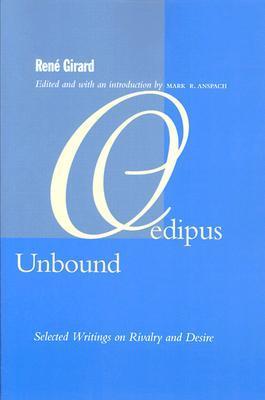
Oedipus Unbound book cover
Oedipus Unbound
Selected Writings on Rivalry and Desire
2004
First Published
3.62
Average Rating
192
Number of Pages
Did Oedipus really kill his father and marry his mother? Or is he nothing but a scapegoat, set up to take the blame for a crisis afflicting Thebes? For René Girard, the mythic accusations of patricide and incest are symptomatic of a plague-stricken community's hunt for a culprit to punish, and Girard succeeds in making us see an age-old myth in a wholly new light. The hard-to-find writings assembled here include three major early essays, never before available in English, which afford a behind-the-scenes glimpse at the emergence of Girard's scapegoat theory from his pioneering analysis of rivalry and desire. Girard unbinds the Oedipal triangle from its Freudian moorings, replacing desire for the mother with desire for anyone―or anything―a rival desires. In a wide-ranging and provocative introduction, Mark R. Anspach presents fresh evidence for Girard's hypotheses from classical studies, literature, anthropology, and the life of Freud himself.

Avg Rating
3.62
Number of Ratings
13
5 STARS
23%
4 STARS
31%
3 STARS
31%
2 STARS
15%
1 STARS
0%
goodreads

Author

Rene Girard
Rene Girard
Author · 25 books

René Girard was a French-born American historian, literary critic, and philosopher of social science whose work belongs to the tradition of anthropological philosophy. He was born in the southern French city of Avignon on Christmas day in 1923. Between 1943 and 1947, he studied in Paris at the École des Chartres, an institution for the training of archivists and historians, where he specialized in medieval history. In 1947 he went to Indiana University on a year’s fellowship and eventually made almost his entire career in the United States. He completed a PhD in history at Indiana University in 1950 but also began to teach literature, the field in which he would first make his reputation. He taught at Duke University and at Bryn Mawr before becoming a professor at Johns Hopkins in Baltimore. In 1971 he went to the State University of New York at Buffalo for five years, returned to Johns Hopkins, and then finished his academic career at Stanford University where he taught between 1981 and his retirement in 1995. Girard is the author of nearly thirty books, with his writings spanning many academic domains. Although the reception of his work is different in each of these areas, there is a growing body of secondary literature on his work and his influence on disciplines such as literary criticism, critical theory, anthropology, theology, psychology, mythology, sociology, economics, cultural studies, and philosophy.Girard’s fundamental ideas, which he has developed throughout his career and provide the foundation for his thinking, are that desire is mimetic (all of our desires are borrowed from other people), that all conflict originates in mimetic desire (mimetic rivalry), that the scapegoat mechanism is the origin of sacrifice and the foundation of human culture, and religion was necessary in human evolution to control the violence that can come from mimetic rivalry, and that the Bible reveals these ideas and denounces the scapegoat mechanism. In 1990, friends and colleagues of Girard’s established the Colloquium on Violence and Religion to further research and discussion about the themes of Girard’s work. The Colloquium meets annually either in Europe or the United States. René Girard died on November 4, 2015, at the age of 91 in Stanford.

548 Market St PMB 65688, San Francisco California 94104-5401 USA
© 2026 Paratext Inc. All rights reserved