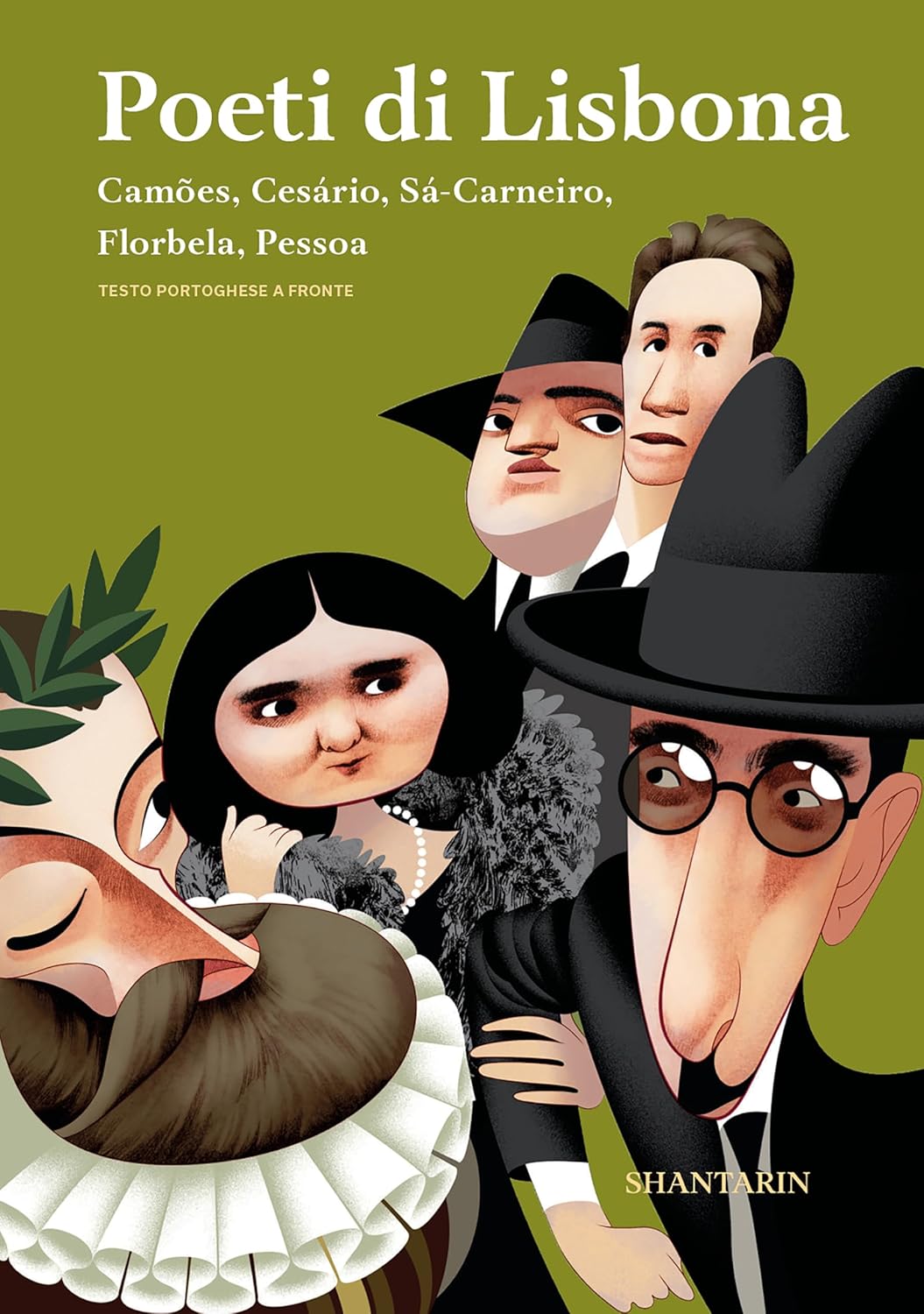



Questa edizione, corredata da illustrazioni e testo originale a fronte, offre a tutti i lettori italiani interessati alla poesia e alla tradizione culturale di Lisbona la possibilità di leggere i versi di alcuni grandi poeti che nacquero o vissero nella leggendaria capitale portoghese. Insieme a Luís de Camões e Fernando Pessoa (con i suoi eteronimi), abbiamo il piacere di proporvi altri tre poeti profondamente radicati nel mondo lusofono: Cesário Verde, Mário de Sá-Carneiro e Florbela Espanca.
Authors

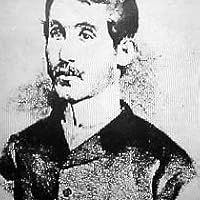
Cesário Verde (February 25, 1855 – July 19, 1886) was a 19th-century Portuguese poet. His work, while mostly ignored during his lifetime and not well known outside of the country’s borders even today, is generally considered to be amongst the most important in Portuguese poetry and is widely taught in schools. This is partly due to his being championed by many other authors after his death, notably Fernando Pessoa. Cesário Verde is frequently hailed as both one of Portugal’s finest urban poets and one of the country’s greatest describers of the countryside. Thus, Verde’s poems (always written in the alexandrine structure) are mostly split into “city poems” and “countryside poems” (the few that escape these two categories dealing with love, often scorned.) Cesário Verde’s city poems are often described as bohemian, decadent and socially aware. He is hailed as Portugal’s first great realist poet, frequently dealing with scenes of poverty, disease and moral decay. His poems also frequently deal with spleen and ennui. In “O Sentimento Dum Ocidental” (“The Feelings Of A Westerner”), Verde captures the atmosphere of decadence then growing in Portuguese society, comparing the past discoveries and expeditions of Portugueses sailors, as well as the works of national poet Luís de Camões, to the present. He also expresses a longing to experience a larger world beyond the city, pining for “Madrid, Paris, Berlim, S. Petersburgo, o mundo!” (“Madrid, Paris, Berlin, St. Petersburg, the world!”) While the city is corrupt and decaying, the countryside in Verde’s poetry is described as lively, fertile and full of beauty. Even the growing industrialization of agriculture isn’t seen as a worrying factor [...] The autobiographical poem “Nós” gives an idyllic description of Verde’s youth living on the farm – latter poems show the countryside as the peaceful setting for picnics, and as an opportunity for long walks with female companionship. Whilst in his “city” poems Verde describes spleen and disease, in his descriptions of the countryside the protagonists are often strong, happy and robust. In his poetry, Cesário Verde references Balzac, Baudelaire and Herbert Spencer. His letters also contain quotes from Victor Hugo, Flaubert, Taine and Quinet. On a national level, the authors referenced are Luís de Camões and João de Deus. Although he was never very celebrated during his lifetime, Verde did socialize with many of the country’s foremost literary figures (some of these meetings may be attributed to Verde’s republican sympathies, then highly in vogue amongst the country’s intellectuals.) Fialho de Almeida is said to have greatly admired him, and other acquaintances include Guerra Junqueiro, Ramalho Ortigão, Gomes Leal, João de Deus, Abel Botelho and the painter Rafael Bordalo Pinheiro. After his death, Verde’s reputation has steadily grown. He was particularly embraced by Portuguese modernists such as Mário de Sá-Carneiro and Fernando Pessoa (whose heteronyms Álvaro de Campos and Alberto Caeiro praise Verde.) More modern admirers include Eugénio de Andrade and Adolfo Casais Monteiro During his lifetime, Cesário Verde published around forty poems in various papers. After his death, his friend Silva Pinto published “The Book Of Cesário Verde”, collecting his poems. The first edition was published in April 1887 – two hundred copies were printed, to be dispensed as gifts only. The compilation was only made available commercially in 1901. More recent editions have respected the order in which the poems were first compiled, but added others that weren’t included in the first selection. The book now includes Verde’s entire poetic oeuvre. Source: http://en.wikipedia.org/wiki/Ces%C3%A...

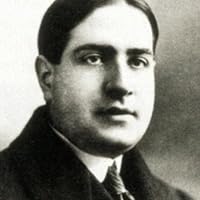
Mário de Sá-Carneiro (Lisboa, 19 de Maio de 1890 — Paris, 26 de Abril de 1916) foi um poeta, contista e ficcionista português, um dos grandes expoentes do modernismo em Portugal e um dos mais reputados membros da Geração d’Orpheu. Na fase inicial da sua obra, Mário de Sá-Carneiro revela influências de várias correntes literárias, como o decadentismo, o simbolismo, ou o saudosismo, então em franco declínio; posteriormente, por influência de Pessoa, viria a aderir a correntes de vanguarda, como o interseccionismo, o paulismo ou o futurismo. Nessas pôde exprimir com vontade a sua personalidade, sendo notórios a confusão dos sentidos, o delírio, quase a raiar a alucinação; ao mesmo tempo, revela um certo narcisismo e egolatria, ao procurar exprimir o seu inconsciente e a dispersão que sentia do seu «eu» no mundo – revelando a mais profunda incapacidade de se assumir como adulto consistente. O narcisismo, motivado certamente pelas carências emocionais (era órfão de mãe desde a mais terna puerícia), levou-o ao sentimento da solidão, do abandono e da frustração, traduzível numa poesia onde surge o retrato de um inútil e inapto. A crise de personalidade levá-lo-ia, mais tarde, a abraçar uma poesia onde se nota o frenesi de experiências sensórias, pervertendo e subvertendo a ordem lógica das coisas, demonstrando a sua incapacidade de viver aquilo que sonhava – sonhando por isso cada vez mais com a aniquilação do eu, o que acabaria por o conduzir, em última análise, ao seu suicídio. Embora não se afaste da metrificação tradicional (redondilhas, decassílabos, alexandrinos), torna-se singular a sua escrita pelos seus ataques à gramática, e pelos jogos de palavras. Se numa primeira fase se nota ainda esse estilo clássico, numa segunda, claramente niilista, a sua poesia fica impregnada de uma humanidade autêntica, triste e trágica. Por fim, as cartas que trocou com Pessoa, entre 1912 e o seu suicídio, são como que um autêntico diário onde se nota paralelamente o crescimento das suas frustrações interiores.

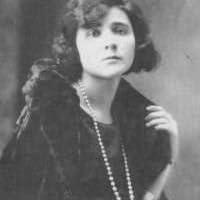
Florbela Espanca (birth name Flor Bela de Alma da Conceição), a poet precursor of the feminist movement in Portugal, she had a tumultuous and eventful life that shaped her erotic and feminine writings. She was baptized as the child of an "unknown" father. After the death of her mother in 1908, Florbela was taken into the care of Maria Espanca and João Maria Espanca, for whom her mother had worked as a maid. João Maria Espanca, who always provided for Florbela (she referred to him in a poem as "dear Daddy of my soul"), officially claimed his paternity in 1949, 19 years after Florbela's death. Florbela's earliest known poem, A Vida e a Morte (Life and Death), was written in 1903. Her first marriage, to Alberto Moutinho, was celebrated on her 19th birthday. After graduating with a literature degree in 1917, she became the first woman to enroll at the law school at the University of Lisbon. Between 1915-1917 she collected all her poems and wrote "O livro D'ele" (His book) that she dedicated to his brother. She had a miscarriage in 1919, the same year that Livro de Mágoas (The Book of Sorrows) was published. Around this time, Florbela began to show the first serious symptoms of Neurosis. In 1921 she divorced her first husband, which exposed her to significant social prejudice. She married António Guimarães in 1922. The work Livro de Soror Saudade (Sister Saudade's Book) was published in 1923. Florbela had a second miscarriage, after which her husband divorced her. In 1925 she married Mário Lage (a doctor that treated her for a long time). Her brother Apeles Espanca died in an airplane crash (some might say he committed suicide, due to her fiancées death), which deeply affected her and inspired the writing of As Máscaras do Destino (The Masks of Destiny). In October and November of 1930, Florbela twice attempted suicide, shortly before the publication of her last book Charneca em Flor (Heath in Bloom). Having been diagnosed with a pulmonary edema, Florbela died on December 8, 1930, on her 36th birthday. Her precarious health and complex mental condition make the actual cause of death a question to this day. Charneca em Flor was published in January 1930. After her death in 1931 «Reliquiare», name given by the italian professor Guido Battelli, was published with the poems she wrote on a further version of "Charneca em Flor».

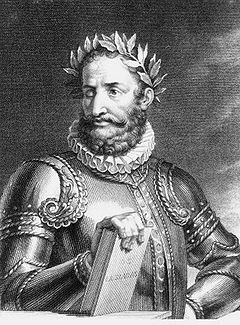
Luís Vaz de Camões (Portuguese pronunciation: [luˈiʃ vaʃ dɨ kaˈmõȷ̃ʃ]; sometimes rendered in English as Camoens; c. 1524 – June 10, 1580) is considered Portugal's, and the Portuguese language's, greatest poet. His mastery of verse has been compared to that of Shakespeare, Vondel, Homer, Virgil, and Dante. He wrote a considerable amount of lyrical poetry (in Portuguese and in Spanish) and drama but is best remembered for his epic work Os Lusíadas (The Lusiads). His recollection of poetry The Parnasum of Luís de Camões was lost in his lifetime. Source: http://en.wikipedia.org/wiki/Lu%C3%AD...

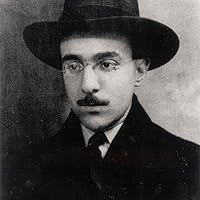
Fernando António Nogueira Pessoa was a poet and writer. It is sometimes said that the four greatest Portuguese poets of modern times are Fernando Pessoa. The statement is possible since Pessoa, whose name means ‘person’ in Portuguese, had three alter egos who wrote in styles completely different from his own. In fact Pessoa wrote under dozens of names, but Alberto Caeiro, Ricardo Reis and Álvaro de Campos were – their creator claimed – full-fledged individuals who wrote things that he himself would never or could never write. He dubbed them ‘heteronyms’ rather than pseudonyms, since they were not false names but “other names”, belonging to distinct literary personalities. Not only were their styles different; they thought differently, they had different religious and political views, different aesthetic sensibilities, different social temperaments. And each produced a large body of poetry. Álvaro de Campos and Ricardo Reis also signed dozens of pages of prose. The critic Harold Bloom referred to him in the book The Western Canon as the most representative poet of the twentieth century, along with Pablo Neruda.