
Margins
2007
First Published
3.53
Average Rating
288
Number of Pages

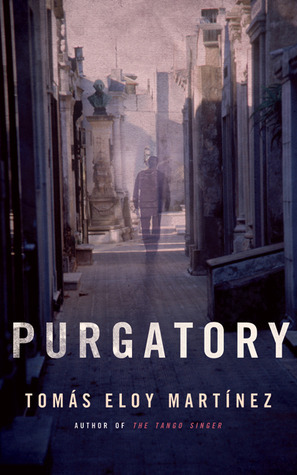
Simón Cardoso had been dead for thirty years when Emilia Dupuy, his wife, found him at lunchtime in the dining room of Trudy Tuesday. So begins Purgatory, the final and perhaps most personal work of the great Latin American novelist Tomás Eloy Martínez. Emilia Dupuy's husband vanished in the 1970s, while the two were mapping an Argentine country road. All evidence seemed to confirm that he was among the thousands disappeared by the military regime. Yet Emilia never stopped believing that the disappeared man would reappear. And then he does, in New Jersey. And for Simón, no time at all has passed. In Martínez's hands, this love story and ghost story becomes a masterful allegory for history political and personal, and for a country's inability to integrate its past with its present. Praise for Santa Evita : "Brilliant…Affirms his place among Latin America's best writers."-New York Times "Here is the novel that I have always wanted to read."-Gabriel García Márquez "A beautiful book, a miracle."-Carlos Fuentes "A master novel…I got choked up, I suffered, I enjoyed."-Mario Vargas Llosa

Avg Rating
3.53
Number of Ratings
651
5 STARS
17%
4 STARS
37%
3 STARS
32%
2 STARS
10%
1 STARS
4%
goodreads

Author

Tomás Eloy Martínez
Tomás Eloy Martínez
Author · 6 books

Tomás Eloy Martínez obtained a degree in Spanish and Latin American literature from the University of Tucumán, and an MA at the University of Paris. From 1957 to 1961 he was a film critic in Buenos Aires for the La Nación newspaper, and he then was editor in chief (1962-69) of the magazine Primera Plana. From 1969 to 1970 he worked as a reporter in Paris. In 1969 Martínez interviewed former Argentine President Juan Domingo Perón, who was exiled in Madrid. These interviews were the basis for two of his more celebrated novels, La Novela de Perón (1985) and Santa Evita (1995). In 1970 he and many former writers of Primera Plana worked at the magazine Panorama, where Martínez was the director. On 15 August 1972 he learned of the uprising of political prisoners in the jail at Rawson, Chubut Province. Panorama was the only publication in Buenos Aires that reported the correct story of the affair in Rawson, which differed significantly from the official version of the de facto Argentine government. On 22 August he was fired at the behest of the government, whereupon he went to Rawson and the neighboring city of Trelew where he reported the Massacre of Trelew in his book The Passion According to Trelew. The book was banned by the Argentine dictatorship. For three years (1972-75) Martínez was in charge of the cultural supplement of La Nación, after which he lived in exile (1975-83) in Caracas, Venezuela, where he remained active as a journalist, founding the newspaper El Diario. In his book "The Memoirs of the General" he recounts that he was threatened by the "Triple A", the Alianza Anticomunista Argentina, and on one occasion, gunmen held a pistol to the head of his 3-year-old son because they were witnesses to a crime Martínez believed to be an operation led by the far-right paramilitary group. He subsequently started the newspaper Siglo 21 in Guadalajara, Mexico, and created the literary supplement Primer Plano for the newspaper Página/12 in Buenos Aires. Martínez has also been a teacher and lecturer. He taught (1984-87) at the University of Maryland. In 1995, he took a position as distinguished professor and director of the Latin American Studies program at Rutgers University, New Jersey. He lived in nearby Highland Park, New Jersey until about 3 years ago when he returned to Argentina to live. He wrote columns for La Nación and the New York Times syndicate, and his articles have appeared in many newspapers and journals in Latin America. He has published a number of books, one of which, Santa Evita, has been translated into 32 languages and published in 50 countries. He was awarded the Guggenheim and Woodrow Wilson fellowships, and won the 2002 Alfaguara award for the novel Flight of the Queen. His works deal primarily (but not exclusively) with Argentina during and after the rule of Juan Domingo Perón and his wife, Eva Duarte de Perón (Evita). Martínez died in Buenos Aires after a long battle against a brain tumor.

548 Market St PMB 65688, San Francisco California 94104-5401 USA
© 2026 Paratext Inc. All rights reserved