Margins
The Anthropocene Epoch book cover 1
The Anthropocene Epoch book cover 2
The Anthropocene Epoch book cover 3
The Anthropocene Epoch
Series · 3 books · 2012-2016

Books in series

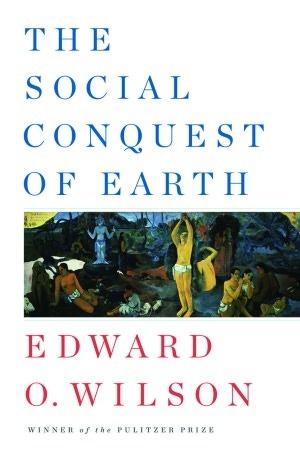
The Social Conquest of Earth book cover
#1

The Social Conquest of Earth

2012

From the most celebrated heir to Darwin comes a groundbreaking book on evolution, the summa work of Edward O. Wilson's legendary career. Where did we come from? What are we? Where are we going? In a generational work of clarity and passion, one of our greatest living scientists directly addresses these three fundamental questions of religion, philosophy, and science while “overturning the famous theory that evolution naturally encourages creatures to put family first” ( Discover magazine). Refashioning the story of human evolution in a work that is certain to generate headlines, Wilson draws on his remarkable knowledge of biology and social behavior to show that group selection, not kin selection, is the primary driving force of human evolution. He proves that history makes no sense without prehistory, and prehistory makes no sense without biology. Demonstrating that the sources of morality, religion, and the creative arts are fundamentally biological in nature, Wilson presents us with the clearest explanation ever produced as to the origin of the human condition and why it resulted in our domination of the Earth’s biosphere. 90 illustrations
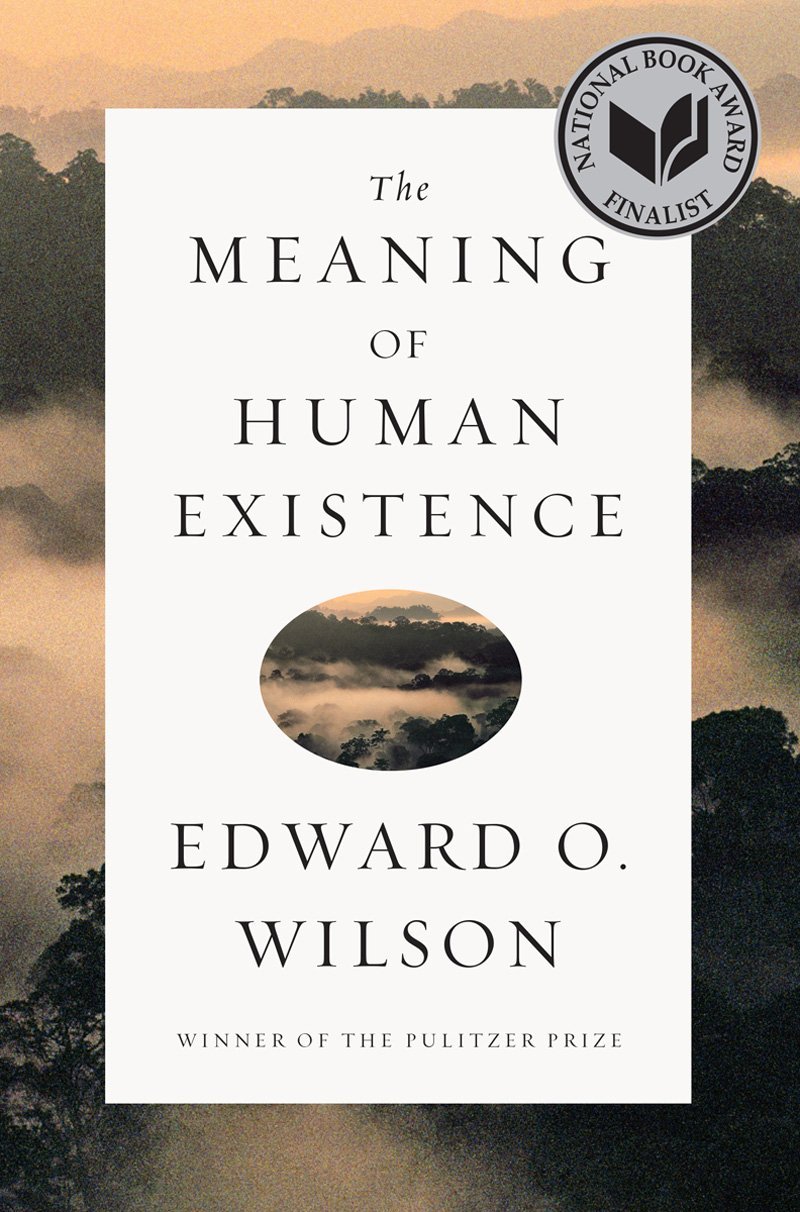
The Meaning of Human Existence book cover
#2

The Meaning of Human Existence

2014

How did humanity originate and why does a species like ours exist on this planet? Do we have a special place, even a destiny in the universe? Where are we going, and perhaps, the most difficult question of all, "Why?" In The Meaning of Human Existence, his most philosophical work to date, Pulitzer Prize–winning biologist Edward O. Wilson grapples with these and other existential questions, examining what makes human beings supremely different from all other species. Searching for meaning in what Nietzsche once called "the rainbow colors" around the outer edges of knowledge and imagination, Wilson takes his readers on a journey, in the process bridging science and philosophy to create a twenty-first-century treatise on human existence—from our earliest inception to a provocative look at what the future of mankind portends. Continuing his groundbreaking examination of our "Anthropocene Epoch," which he began with The Social Conquest of Earth, described by the New York Times as "a sweeping account of the human rise to domination of the biosphere," here Wilson posits that we, as a species, now know enough about the universe and ourselves that we can begin to approach questions about our place in the cosmos and the meaning of intelligent life in a systematic, indeed, in a testable way. Once criticized for a purely mechanistic view of human life and an overreliance on genetic predetermination, Wilson presents in The Meaning of Human Existence his most expansive and advanced theories on the sovereignty of human life, recognizing that, even though the human and the spider evolved similarly, the poet's sonnet is wholly different from the spider's web. Whether attempting to explicate "The Riddle of the Human Species," "Free Will," or "Religion"; warning of "The Collapse of Biodiversity"; or even creating a plausible "Portrait of E.T.," Wilson does indeed believe that humanity holds a special position in the known universe. The human epoch that began in biological evolution and passed into pre-, then recorded, history is now more than ever before in our hands. Yet alarmed that we are about to abandon natural selection by redesigning biology and human nature as we wish them, Wilson soberly concludes that advances in science and technology bring us our greatest moral dilemma since God stayed the hand of Abraham.

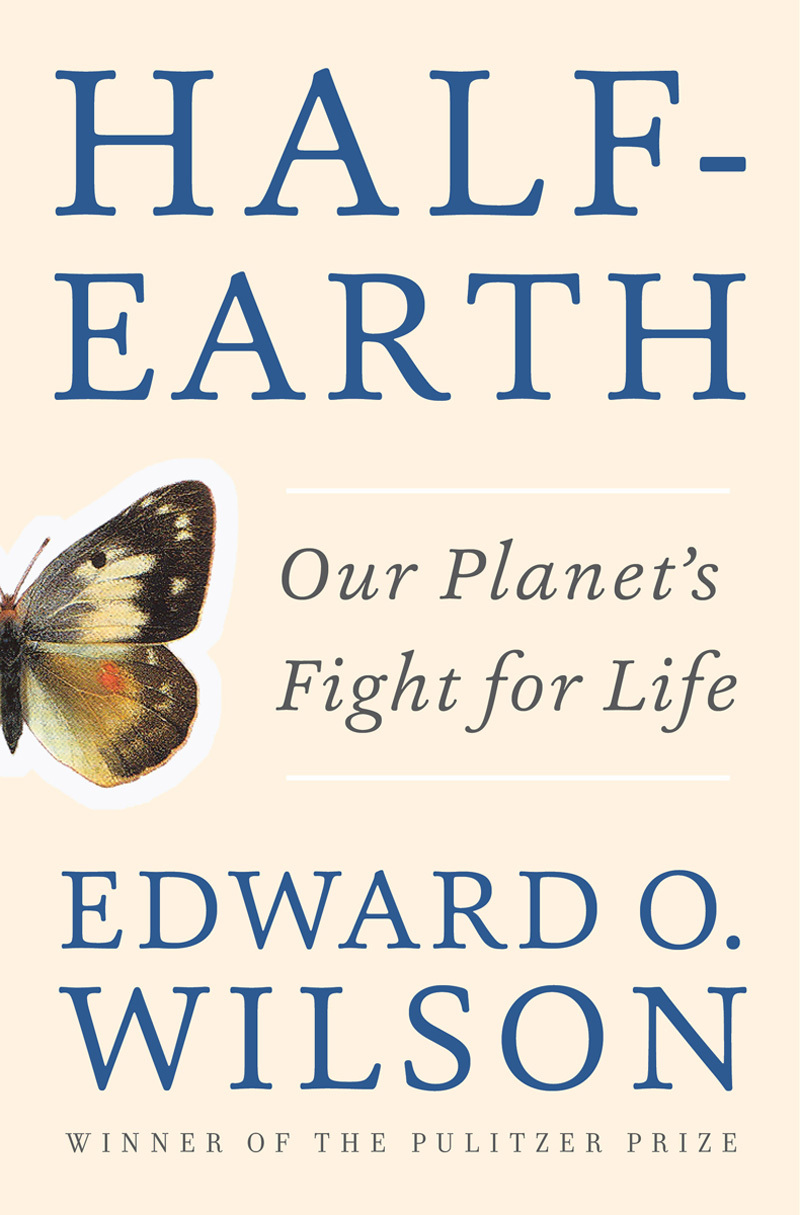
Half-Earth book cover
#3

Half-Earth

Our Planet's Fight for Life

2016

In order to stave off the mass extinction of species, including our own, we must move swiftly to preserve the biodiversity of our planet, says Edward O. Wilson in his most impassioned book to date. Half-Earth argues that the situation facing us is too large to be solved piecemeal and proposes a solution commensurate with the magnitude of the problem: dedicate fully half the surface of the Earth to nature. If we are to undertake such an ambitious endeavor, we first must understand just what the biosphere is, why it's essential to our survival, and the manifold threats now facing it. In doing so, Wilson describes how our species, in only a mere blink of geological time, became the architects and rulers of this epoch and outlines the consequences of this that will affect all of life, both ours and the natural world, far into the future. Half-Earth provides an enormously moving and naturalistic portrait of just what is being lost when we clip "twigs and eventually whole braches of life's family tree." In elegiac prose, Wilson documents the many ongoing extinctions that are imminent, paying tribute to creatures great and small, not the least of them the two Sumatran rhinos whom he encounters in captivity. Uniquely, Half-Earth considers not only the large animals and star species of plants but also the millions of invertebrate animals and microorganisms that, despite being overlooked, form the foundations of Earth's ecosystems. In stinging language, he avers that the biosphere does not belong to us and addresses many fallacious notions such as the idea that ongoing extinctions can be balanced out by the introduction of alien species into new ecosystems or that extinct species might be brought back through cloning. This includes a critique of the "anthropocenists," a fashionable collection of revisionist environmentalists who believe that the human species alone can be saved through engineering and technology. Despite the Earth's parlous condition, Wilson is no doomsayer, resigned to fatalism. Defying prevailing conventional wisdom, he suggests that we still have time to put aside half the Earth and identifies actual spots where Earth's biodiversity can still be reclaimed. Suffused with a profound Darwinian understanding of our planet's fragility, Half-Earth reverberates with an urgency like few other books, but it offers an attainable goal that we can strive for on behalf of all life.

Author

Edward O. Wilson
Edward O. Wilson
Author · 46 books
Edward Osborne Wilson, sometimes credited as E.O. Wilson, was an American biologist, researcher, theorist, and author. His biological specialty is myrmecology, a branch of entomology. A two-time winner of the Pulitzer Prize for General Non-Fiction, Wilson is known for his career as a scientist, his advocacy for environmentalism, and his secular-humanist ideas pertaining to religious and ethical matters. He was the Pellegrino University Research Professor in Entomology for the Department of Organismic and Evolutionary Biology at Harvard University and a Fellow of the Committee for Skeptical Inquiry. He is a Humanist Laureate of the International Academy of Humanism.
548 Market St PMB 65688, San Francisco California 94104-5401 USA
© 2026 Paratext Inc. All rights reserved