Margins




548 Market St PMB 65688, San Francisco California 94104-5401 USA
© 2026 Paratext Inc. All rights reserved
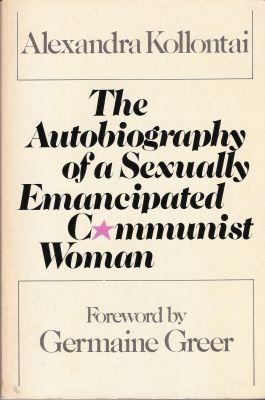
Prefatory Note This is the first time that the complete autobiography which Alexandra Kollontai wrote in 1926 has been published. The sentences and paragraphs in italics were crossed out in the galleyproofs and left out in her time. Variants were indicated in footnotes which likewise were rejected and crossed out. The reader thus will have an idea of the extent and the intensity of corrections made by the author under the pressure of the gradually sharpening Stalinist control. an excerpt from the opening: The Aims and Worth of My Life Nothing is more difficult than writing an autobiography. What should be emphasized? Just what is of general interest? It is advisable, above all, to write honestly and dispense with any of the conventional introductory protestations of modesty. For if one is called upon to tell about one's life so as to make the events that made it what it became useful to the general public, it can mean only that one must have already wrought something positive in life, accomplished a task that people recognize. [1] Accordingly it is a matter of forgetting that one is writing about oneself, of making an effort to abjure one's ego so as to give an account, as objectively as possible, of one's life in the making and of one's accomplishments. I intend to make this effort but whether it will turn out successfully is something else again. At the same time I must confess that, in a certain sense, this autobiography poses a problem for me. For by looking back while prying, simultaneously, into the future, I will also be presenting to myself the most crucial turning points of my being and accomplishments. In this way I [2a] may succeed in setting into bold relief that which concerns the women's liberation struggle and, further, the social significance which it has.[2] That I ought not to shape my life according to the given model, that I would have to grow beyond myself in order to be able to discern my life's true line of vision was an awareness that was mine already in my youngest years. At the same time I was also aware [3] that in this way I could help my sisters to shape their lives, in accordance not with the given traditions but with their own free choice to the extent, of course, that social and economic circumstances permit. I always believed that the time inevitably must come when woman will be judged by the same moral standards applied to man. For it is not her specific feminine virtue that gives her a place of honor in human society, but the worth of the useful mission accomplished by her, [4a] the worth of her personality as human being, as citizen, [4b] as thinker, as fighter. Footnotes [1] Author's correction: created something which is recognized by society. [2a] perhaps [2] Author's correction: to emphasize that which has an importance for the solution of the social problems of our time, and which also includes the great problem of complete women's liberation. Author's note with respect to 2: delete [3] Author's correction: I had a certain presentiment [4a] for society [4b] as creative worker
