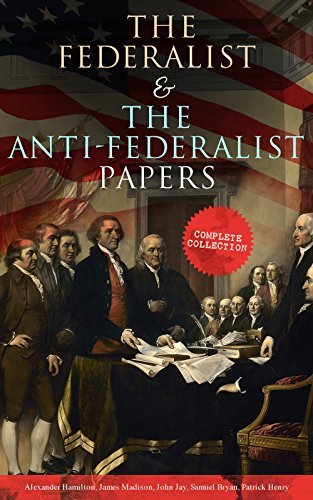



This carefully crafted ebook: "Federalist & The Anti-Federalist Papers" is formatted for your eReader with a functional and detailed table of contents. This collection contains the crucial decisions and arguments of the Founding Fathers which shaped the America we know today. Along with the Constitution, Bill of Rights and the various Amendments this book is sure to help you understand the basic tenets of the American democracy: Contents: Need for Stronger Union Federalist: I, II, III, IV, V, VI Anti-Federalist: John Dewitt I, John Dewitt II Bill of Rights Federalist: LXXXIV Anti-Federalist: John Dewitt II Nature and Powers of the Union Federalist: I, XIV, XV Anti-Federalist: Patrick Henry June 5, 1788 Responsibility and Checks in Self-government Federalist: X, LI Anti-Federalist: Centenel I Extent of Union, States' Rights, Bill of Rights, Taxation Federalist: X, XXXII, XXXIII, XXXV, XXXVI, XXXIX, XLV, LXXXIV Anti-Federalist: Brutus I Extended Republics, Taxation Federalist: VII, X, XIV, XXXV, XXXVI Anti-Federalist: Federal Farmer I, Federal Farmer II Broad Construction, Taxing Powers Federalist: XXIII, XXX, XXXI, XXXII, XXXIII, XXXIV Anti-Federalist: Brutus VI Defense, Standing Armies Federalist: XXIV, XXV, XXVI, XXVII, XXVIII, XXIX Anti-Federalist: Brutus X The Judiciary Federalist: LXXVIII, LXXIX, LXXX, LXXXI, LXXXII, LXXXIII Anti-Federalist: Brutus XI, Brutus XII, Brutus XV Government Resting on the People Federalist: XXIII, XLIX Anti-Federalist: John Dewitt III Executive Power Federalist: LXVII Anti-Federalist: Cato V Regulating Elections Federalist: LIX Anti-Federalist: Cato VII House of Representatives Federalist: XXVII, XXVIII, LII, LIII, LIV, LVII Anti-Federalist: Brutus IV The Senate Federalist: LXII, LXIII Anti-Federalist: Brutus XVI Articles of Confederation (1777) Declaration of Independence (1776) U.S. Constitution (1787) Bill of Rights (1791) Amendments (1792-1991)
Authors

Librarian Note: There is more than one author in the GoodReads database with this name. See this thread for more information. American politician Alexander Hamilton, the first secretary of the treasury of United States from 1789 to 1795, established the national bank and public credit system; a duel with Aaron Burr, his rival, mortally wounded him. One of the Founding Fathers, this economist and philosopher led calls for the convention at Philadelphia and as first Constitutional lawyer co-wrote the Federalist Papers , a primary source for Constitutional interpretation. During the Revolutionary War, he, born in the West Indies but educated in the north, joined the militia, which chose him artillery captain. Hamilton, senior aide-de-camp and confidant to George Washington, general, led three battalions at the siege of Yorktown. People elected him to the Continental congress, but he resigned to practice law and to found in New York. He served in the legislature of New York and later returned to Congress; at the convention in Philadelphia, only he signed the Constitution for New York. Under Washington, then president, he influenced formative government policy widely. Hamilton, an admirer of British, emphasized strong central government and implied powers, under which the new Congress funded and assumed the debts and created an import tariff and whiskey tax. A coalition, the formative Federalist Party, arose around Hamilton, and another coalition, the formative Democratic-Republican Party, arose around Thomas Jefferson and James Madison before 1792; these coalitions differed strongly over domestic fiscal goals and Hamiltonian foreign policy of extensive trade and friendly relations with Britain. Exposed in an affair with Maria Reynolds, Hamilton resigned to return to Constitutional law and advocacy of strong federalism. In 1798, the quasi-war with France led him to argue for an army, which he organized and commanded de facto. Opposition of Hamilton to John Adams, fellow Federalist, contributed to the success of Thomas Jefferson, a Democratic-Republican, in the uniquely deadlocked election of 1800. With defeat of his party, his industrializing ideas lost their former prominence. In 1801, Hamilton founded the Federalist broadsheet New-York Evening Post, now known as the New York Post. His intensity with the vice-president eventually resulted in his death. After the war of 1812, Madison, Albert Gallatin, and other former opponents of the late Hamilton revived some of his federalizing programs, such as infrastructure, tariffs, and a standing Army and Navy. His Federalist and business-oriented economic visions for the country continue to influence party platforms to this day.