Margins
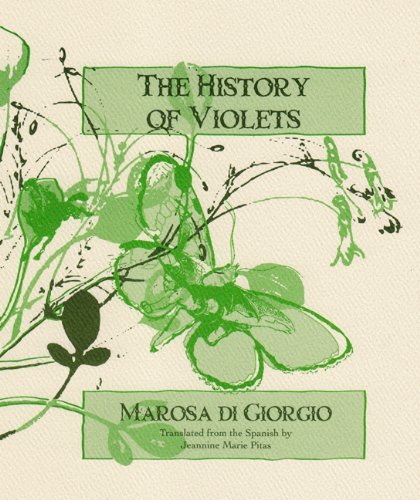
The History of Violets book cover
The History of Violets
1965
First Published
4.36
Average Rating
88
Number of Pages
Bilingual poetry book in Spanish and English. "Originally published in 1965, The History of Violets (Historial de las violetas) twists the familiar face of a family farm, populating the fields and grounds with gods, monsters, and a whole "foamy army" of extras. Di Giorgio—whom Kent Johnson hails as "one of the most spectacular and strange Latin American poets of the past fifty years"—locks the natural and supernatural in a perilous dance, balancing humor and violence, beauty and danger, simple childhood memory and complex domestic drama. With disarming grace, these poems leave the reader swirling about, among the flowers, where no one is safe." (From Ugly Duckling Presse's webpage at http://www.uglyducklingpresse.org/cat...)

Avg Rating
4.36
Number of Ratings
104
5 STARS
58%
4 STARS
23%
3 STARS
16%
2 STARS
3%
1 STARS
0%
goodreads

Author

Marosa Di Giorgio
Marosa Di Giorgio
Author · 8 books

Marosa di Giorgio (1932–2004) was a Uruguayan poet and novelist. Marosa di Giorgio is considered one of the most singular voices in Latin America. Critics tend to agree that her writing is greatly influenced by European surrealism, although her vocabulary, style, and imagery are uniquely her own. Her work deals predominately with the imaginary world of childhood and nature. In the past few years, Latin American critics such as Hugo Achugar, Luis Bravo, Leonardo Garet, Sylvia Guerra, María Alejandra Minelli, and María Rosa Olivera-Williams have explored Marosa Di Giorgio's writing. Uruguayan poet Roberto Echavarren published in 1991 "Transplatinos", which offers an excellent introduction to Di Giorgio's writing. Selected poems from The March Hare have been translated into English by K.A. Kopple and published in the 1995 by Exact Change Yearbook. An article discussing gender politics, parody, and desire (as elaborated by Gilles Deleuze) also written by K.A. Kopple appeared in March 2000 in the Journal of Latin American Cultural Studies. In'Identity, Nation, Discourse: Latin American Women Writers and Artists, edited by Claire Taylor (Cambridge Scholars Publishing, 2009), Soledad Montañez opens up a new discussion of Di Giorgio's erotic writing. Montañez shows how "Di Giorgio's erotic prose illustrates the representation and performance of patriarchal hierarchy as a perverse comedy, creating a genre that constructs gender narratives in order to undermine the patriarchal system from within."Montañez also affirms that "The effect achieved in Marosa's radicalised narrative is ultimately a mocking performance, a burlesque discourse that reveals and denounces domination and power. Through a perverse representation Marosa exposes the complicated matter of culturally constructed sexual norms and develops a writing that is at the same time disturbing and astonishing" (2009: 158). In 1982 she received the Fraternity Award for literature

548 Market St PMB 65688, San Francisco California 94104-5401 USA
© 2026 Paratext Inc. All rights reserved