Margins




548 Market St PMB 65688, San Francisco California 94104-5401 USA
© 2026 Paratext Inc. All rights reserved
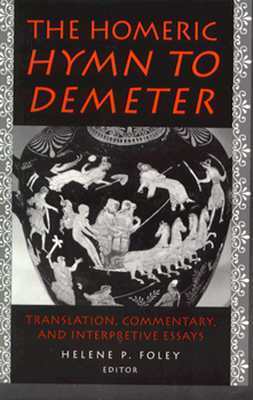
The Homeric Hymn to Demeter, composed in the late 7th or early 6th century BCE, reflects on the psychological & religious world of ancient Greek women. It tells how Hades abducted Persephone & how her mother, the grain goddess Demeter, forced the gods to allow Persephone to return to her part of each year. Foley presents the Greek text, an annotated translation & selected essays on its historical context & its religious, literary, social & psychological meaning. The Hymn reflects both the crisis when marriage separates mother & daughter as well as the bonds allowing them to survive this transition. Demeter & Persephone, who suffered the pains of mortality, found the Eleusinian Mysteries that offered their initiates a "different lot once dead in the dreary darkness." A version of the same myth formed the basis of exclusively female religious cults. The essays, contributed by Foley, Mary Louise Lord, Jean Rudhardt & Nancy Felson-Rubin, Harriet M. Deal, Marilyn Arthur Katz, & Nancy Chodorow, give a rich understanding of the Hymn's structure & artistry, its role in the religious life of the ancient world & its meaning for moderns. The essays study the Hymn in the context of early Greek epic & cosmology, examine its critical attitude to marriage & analyze mother-daughter dynamics. Text & Translation of the Homeric Hymn to Demeter Commentary on the Homeric Hymn to Demeter Background: The Eleusinian Mysteries & Women's Rites for Demeter Interpreting the Hymn to Demeter The "Theology" of the Mysteries Variants of the Myth & the Importance of the Version in the Hymn to Demeter Female Experience in the Hymn to Demeter Marriage Gender Conflict & the Cosmological Tradition The Mother/Daughter Romance The Psychology of the Mysteries The Hymn to Demeter & the Polis Christianity & the Hymn to Demeter The Influence of the Hymn to Demeter & Its Myth