Part of Series


The Western Lands is the eagerly awaited new novel by the most visionary American novelist of the twentieth century—a haunting Book of the Dead for the nuclear age. Every new work from the pen of William S. Burroughs is an important literary event. This is especially so in the case of The Western Lands. For in this novel, Burroughs completes a trilogy that began with Cities of the Red Night and The Place of Dead Roads, with a profound, revealing, and often astounding meditation on the themes of mortality, loneliness, nuclear peril—and the inextinguishable hope for an existence beyond bodily death. The symbolic vehicle Burroughs uses here is ancient Egyptian mythology, a long-standing interest of his. "The Western Lands" of the title are the territory to which the Egyptians believed the souls of the dead made a hazardous pilgrimage in their quest for true immortality. The questers—Joe the Dead, Kim Carsons, the scribe Neferti, Hassan i Sabbah, the Old Man of the Mountain—travel through an unmistakably Burroughs-esque universe of appalling danger and otherworldly beauty—now the back alleys of ancient Egypt, now bombed-out Berlin, now the Old West of the shootists. Their hallucinatory journeys express the author's belief that only through facing the most extreme dangers and testing the possibilities of biological mutation can man escape a dead-end world of blasted dreams and atomic finale. And presiding over all is the haunting figure of "the old writer," who shares in the fate of his characters in being finally unable to write himself out of Time, and into Space. The Western Lands continues and extends one of the great literary odysseys of our time, adding to Burroughs' awesome literary style and black humor chilling touches of elegy and autobiography. It is at once Burroughs' most personal and most universal work, yet another masterwork from the reigning genius of the American literary avant-garde.
Author
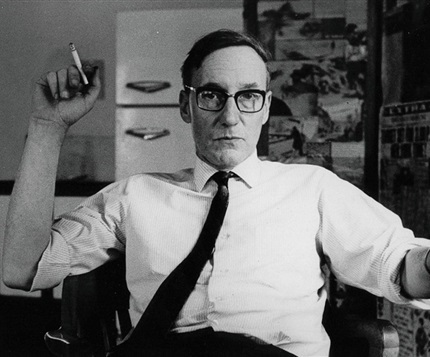
William Seward Burroughs II, (also known by his pen name William Lee) was an American novelist, short story writer, essayist, painter, and spoken word performer. A primary figure of the Beat Generation and a major postmodernist author, he is considered to be "one of the most politically trenchant, culturally influential, and innovative artists of the 20th century". His influence is considered to have affected a range of popular culture as well as literature. Burroughs wrote 18 novels and novellas, six collections of short stories and four collections of essays. Five books have been published of his interviews and correspondences. He also collaborated on projects and recordings with numerous performers and musicians, and made many appearances in films. He was born to a wealthy family in St. Louis, Missouri, grandson of the inventor and founder of the Burroughs Corporation, William Seward Burroughs I, and nephew of public relations manager Ivy Lee. Burroughs began writing essays and journals in early adolescence. He left home in 1932 to attend Harvard University, studied English, and anthropology as a postgraduate, and later attended medical school in Vienna. After being turned down by the Office of Strategic Services and U.S. Navy in 1942 to serve in World War II, he dropped out and became afflicted with the drug addiction that affected him for the rest of his life, while working a variety of jobs. In 1943 while living in New York City, he befriended Allen Ginsberg and Jack Kerouac, the mutually influential foundation of what became the countercultural movement of the Beat Generation. Much of Burroughs' work is semi-autobiographical, primarily drawn from his experiences as a heroin addict, as he lived throughout Mexico City, London, Paris, Berlin, the South American Amazon and Tangier in Morocco. Finding success with his confessional first novel, Junkie (1953), Burroughs is perhaps best known for his third novel Naked Lunch (1959), a controversy-fraught work that underwent a court case under the U.S. sodomy laws. With Brion Gysin, he also popularized the literary cut-up technique in works such as The Nova Trilogy (1961–64). In 1983, Burroughs was elected to the American Academy and Institute of Arts and Letters, and in 1984 was awarded the Ordre des Arts et des Lettres by France. Jack Kerouac called Burroughs the "greatest satirical writer since Jonathan Swift", a reputation he owes to his "lifelong subversion" of the moral, political and economic systems of modern American society, articulated in often darkly humorous sardonicism. J. G. Ballard considered Burroughs to be "the most important writer to emerge since the Second World War", while Norman Mailer declared him "the only American writer who may be conceivably possessed by genius". Burroughs had one child, William Seward Burroughs III (1947-1981), with his second wife Joan Vollmer. Vollmer died in 1951 in Mexico City. Burroughs was convicted of manslaughter in Vollmer's death, an event that deeply permeated all of his writings. Burroughs died at his home in Lawrence, Kansas, after suffering a heart attack in 1997.