Margins




548 Market St PMB 65688, San Francisco California 94104-5401 USA
© 2026 Paratext Inc. All rights reserved
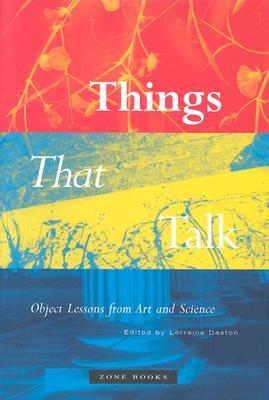
Imagine a world without things. There would be nothing to describe, explain, remark on, interpret, or complain about. Without things, we would, in short, stop speaking; we would become as mute as objects are alleged to be. In nine original essays, internationally renowned historians of art and of science seek to understand how objects become charged with significance without losing their gritty materiality. Things That Talk aims to escape the opposition between positivist facts and cultural readings that bifurcates the current historiography of both art and science. Confronting this impasse from an interdisciplinary perspective, each author singles out one object for close a Bosch drawing, the freestanding column, a Prussian island, soap bubbles, early photographs, glass flowers, Rorschach blots, newspaper clippings, paintings by Jackson Pollock. Each object is revealed to be a node around which meanings accrete thickly. But not just any what these things are made of and how they are made shape what they can mean. Neither the pure texts of semiotics nor the brute objects of positivism, these things are saturated with cultural significance. Things become talkative when they fuse matter and meaning; they lapse into speechlessness when their matter and meanings no longer mesh. Each of the nine evocative objects examined in this book had its historical moment, when the match of this thing to that thought seemed irresistible. At such junctures, certain things become objects of fascination, association, and endless consideration. Things That Talk fleetingly realizes the dream of a perfect language, in which words and world merge. Essays by Lorraine Daston, Peter Galison, Anke te Heesen, Caroline A. Jones, Joseph Leo Koerner, Antoine Picon, Simon Schaffer, Joel Snyder, and M. Norton and Elaine M. Wise.