



I H.G. Wells bok Tidsmaskinen får vi möta en engelsk gentleman och uppfinnare. Mannen, som förblir namnlös i hela berättelsen, har byggt en tidsmaskin och tar med läsaren på sina resor långt in i framtiden. En framtid som på inget sätt påminner om hans hemtrevliga viktorianska Surrey och innehåller minst lika många frågor som svar. Med Tidsmaskinen fortsätter vi att ge ut Per Demervalls nybearbetningar av H.G. Wells klassiker. De rör sig i gränslandet mellan serier och lättlästa böcker och fångar perfekt känslan som gjort dessa böcker till klassiker. Med Tidsmaskinen får vi se hur framtidens dystopiska landskap kan te sig genom Demervalls filter samtidigt som vi får oss ett spännande äventyr till livs. Passar perfekt för när man ska läsa klassiker på högstadiet. Boken ingår i Wells klassiker serie: #1 Världarnas krig #2 Den osynlige mannen #3 Tidsmaskinen #4 Doktor Moreaus ö
Author

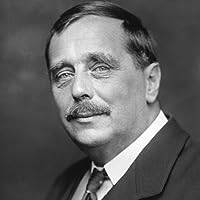
Herbert George Wells was born to a working class family in Kent, England. Young Wells received a spotty education, interrupted by several illnesses and family difficulties, and became a draper's apprentice as a teenager. The headmaster of Midhurst Grammar School, where he had spent a year, arranged for him to return as an "usher," or student teacher. Wells earned a government scholarship in 1884, to study biology under Thomas Henry Huxley at the Normal School of Science. Wells earned his bachelor of science and doctor of science degrees at the University of London. After marrying his cousin, Isabel, Wells began to supplement his teaching salary with short stories and freelance articles, then books, including The Time Machine (1895), The Island of Dr. Moreau (1896), The Invisible Man (1897), and The War of the Worlds (1898). Wells created a mild scandal when he divorced his cousin to marry one of his best students, Amy Catherine Robbins. Although his second marriage was lasting and produced two sons, Wells was an unabashed advocate of free (as opposed to "indiscriminate") love. He continued to openly have extra-marital liaisons, most famously with Margaret Sanger, and a ten-year relationship with the author Rebecca West, who had one of his two out-of-wedlock children. A one-time member of the Fabian Society, Wells sought active change. His 100 books included many novels, as well as nonfiction, such as A Modern Utopia (1905), The Outline of History (1920), A Short History of the World (1922), The Shape of Things to Come (1933), and The Work, Wealth and Happiness of Mankind (1932). One of his booklets was Crux Ansata, An Indictment of the Roman Catholic Church. Although Wells toyed briefly with the idea of a "divine will" in his book, God the Invisible King (1917), it was a temporary aberration. Wells used his international fame to promote his favorite causes, including the prevention of war, and was received by government officials around the world. He is best-remembered as an early writer of science fiction and futurism. He was also an outspoken socialist. Wells and Jules Verne are each sometimes referred to as "The Fathers of Science Fiction". D. 1946. More: http://philosopedia.org/index.php/H.\_... http://www.online-literature.com/well... http://www.hgwellsusa.50megs.com/ http://www.britannica.com/EBchecked/t... http://en.wikipedia.org/wiki/H.\_G.\_Wells