Margins
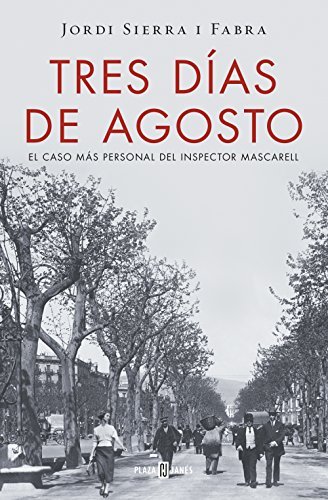
Tres días de agosto book cover
Tres días de agosto
2016
First Published
4.12
Average Rating
320
Number of Pages

Part of Series

El séptimo caso del inspector Mascarell, la serie de novela policíaca de Jordi Sierra i Fabra. Miquel Mascarell tiene tres días para resolver un misterio que se ha mantenido en pie desde hace doce años y que está relacionado con los bombardeos de 1938 en Barcelona. Agosto de 1950. Miquel y Patro se disponen a pasar un día de playa. Sin embargo, todo se torcerá cuando ella desaparezca y él reciba una nota muy explícita: si no resuelve en tres días un caso que dejó inconcluso en 1938, Patro morirá. Desde este instante, a contrarreloj, en una Barcelona batida por la canícula estival, Miquel deberá enfrentarse a los fantasmas del pasado una vez más. El caso que no concluyó, debido a una intempestiva enfermedad, y que resolvió otro inspector demasiado rápidamente causando la muerte de un inocente, se remonta a los crueles bombardeos de marzo de 1938 sobre la ciudad. Bombardeos que, después de Guernica, fueron los más sanguinarios y salvajes de la guerra. La bomba que hizo saltar por los aires la esquina de la Gran Vía con la calle de Balmes es el detonante para la novela. Allí apareció el cadáver de un soldado que no murió por la explosión, sino asesinado. ¿Por quién? ¿Por qué? Además, en plena investigación, descubrirá algo que va a cambiarle la vida. Algo que atañe a Patro. Algo que le hará sudar por algo más que por el calor.

Avg Rating
4.12
Number of Ratings
233
5 STARS
34%
4 STARS
47%
3 STARS
15%
2 STARS
3%
1 STARS
0%
goodreads

Author

Jordi Sierra i Fabra
Author · 170 books

1947 —Born in Barcelona, July 26th. 1955 —Serious accident. First literary incursions. 1959 —First full-length novel, 500 pages. Firm intention to become a writer. 1964 —Graduates from high school. Attends technical school at night and works during the day for a construction company. 1968 —First professional attempts in the musical field. Founder of and collaborator in El Gran Musical radio programme (Cadena SER, Madrid). Additional collaborations with Radio Barcelona. —Writes articles and collaborations for La Prensa in Barcelona and for Nuevo Diario in Madrid. 1969 —Correspondent for El Gran Musical in Barcelona. 1970 —Quits job and studies to work full-time as a music critic. Manages the weekly magazine Disco Express. —Starts travelling all over the world with top musicians. 1972 —First book published: 1962-72 Historia de la música pop (1962-72 A history of pop music), the first work in its genre published in Spain and a best-seller. —Works as an editorial adviser, collaborating, writing and founding several music magazines, such as Top Magazine and Extra. 1973 —Founds and features in Popular 1, a pioneer monthly magazine about rock. 1974 —Becomes executive manager of Popular 1. —Finalist to the Ciudad de Murcia Literature Prize. —Hosts the Semanario Informativo de la Música Pop (Pop Music Weekly News), a radio programme to be aired for four years on Barcelona’s Radio Peninsular. 1975 —Villa de Bilbao Novel Prize. 1976 —Resigns as executive manager of Popular 1 to devote himself to literature and travelling. —Beginning of the musical anthology collection (biographies and history) Música de Nuestro Tiempo (Music of Our Time). Writes and publishes 24 books in the following years. 1977 —Co-founder of Super-Pop magazine, on young people’s music. Number one in Spain in its category after only a few months in print. 1978 —Finalist to the Planeta Novel Prize. —Resigns as manager of Disco Express after 9 years. 1979 —Ateneo de Sevilla Novel Prize. 1981 —Gran Angular Young People’s Literature Prize. —Begins publishing Historia de la música rock (A history of rock music) in 100 instalments (6 volumes) over 2 years. 1982 —First lecture circuits for primary and secondary schools around Spain, prompted by the boom in children and young people’s literature. Continues activities in schools to this day, giving more than 100 lectures a year. 1983 —Wins Gran Angular Youth Literature Prize for the second time. 1985 —Birth of the detective character Daniel Ross. 1987 —Author of the radio serial Ya es de oro (Gold Already) for Cadena SER. 1988 —Births of the literary characters Zuk-1 and Sam Numit. —El joven Lennon (Young Lennon) remains on the young adult fiction best-seller list for 11 months. —First books translated into Italian, German, French, Greek, Bulgarian, Portuguese, Slovenian, Dutch, English, Japanese, etc. (still translated to this day). 1989 —Birth of Victor, another literary character. —First Daniel Ross film on TV, La sombra del delator (The shadow of the informer), aired on March 1994 with Mario Gas and Manuel Aleixandre in the leading roles. 1990 —Vaixell de Vapor Children’s Literature Prize. —Timun Mas begins publishing Sam Numit. A total of 6 books in 2 years. —Designs a trivia game on rock music. 1991 —Wins the Gran Angular Young People’s Literature Prize for the third time in 10 years. 1992 —Wins the CCEI 1991 Best Children’s Book Prize. —Diccionario de los Beatles (A Beatles Dictionary), first book in the world published under this concept and title. 1993 —Publishes the encyclopaedia Los grandes del rock de la A a la Z (Rock legends from A to Z) in Italy, titled Los mitos del rock en vivo (Live rock legends), 100 instalments, 5 volumes.

548 Market St PMB 65688, San Francisco California 94104-5401 USA
© 2026 Paratext Inc. All rights reserved