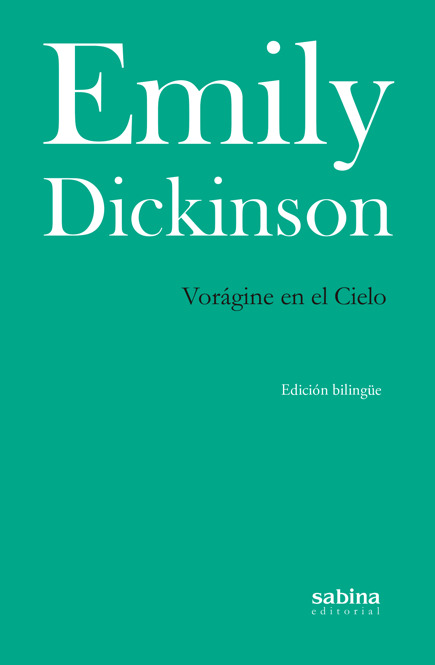



Para Emily Dickinson la vivencia del Paraíso está ligada tanto a la inmortalidad como a su realización aquí en la tierra. Una muestra son los veintiséis poemas de este libro, donde las referencias a la Eternidad, la Inmortalidad y el Paraíso son parte de su experiencia vital de la poesía y del amor, que conducen a la plenitud: “Las únicas noticias que sé / Son todo el Día Comunicados / Desde la Inmortalidad.”. El amor que vivió con Susan Huntington Dickinson es su otro modo de vivir la experiencia de la inmortalidad. Ese amor fue su medida: “No en otra parte – aunque en Paraíso / Sea encontrado su Equivalente -”. La puerta que abre la poeta no siempre es fácil de traspasar, y la inspiración tiene su precio, esa “divina intoxicación” se vive en última instancia en soledad; pero mediante la palabra poética consigue iluminar un lugar que existe dentro de cada vida humana, como escribe en otro poema: “Cada Vida converge hacia algún Centro – / Expresado – o callado –“ Y hay tanta potencia, tanta perfección en lo que transmite que su poesía tiene la capacidad de transportarnos.
Author

Emily Dickinson was an American poet who, despite the fact that less than a dozen of her nearly eighteen hundred poems were published during her lifetime, is widely considered one of the most original and influential poets of the 19th century. Dickinson was born to a successful family with strong community ties, she lived a mostly introverted and reclusive life. After she studied at the Amherst Academy for seven years in her youth, she spent a short time at Mount Holyoke Female Seminary before returning to her family's house in Amherst. Thought of as an eccentric by the locals, she became known for her penchant for white clothing and her reluctance to greet guests or, later in life, even leave her room. Most of her friendships were therefore carried out by correspondence. Although Dickinson was a prolific private poet, fewer than a dozen of her nearly eighteen hundred poems were published during her lifetime.The work that was published during her lifetime was usually altered significantly by the publishers to fit the conventional poetic rules of the time. Dickinson's poems are unique for the era in which she wrote; they contain short lines, typically lack titles, and often use slant rhyme as well as unconventional capitalization and punctuation.Many of her poems deal with themes of death and immortality, two recurring topics in letters to her friends. Although most of her acquaintances were probably aware of Dickinson's writing, it was not until after her death in 1886—when Lavinia, Emily's younger sister, discovered her cache of poems—that the breadth of Dickinson's work became apparent. Her first collection of poetry was published in 1890 by personal acquaintances Thomas Wentworth Higginson and Mabel Loomis Todd, both of whom heavily edited the content. A complete and mostly unaltered collection of her poetry became available for the first time in 1955 when The Poems of Emily Dickinson was published by scholar Thomas H. Johnson. Despite unfavorable reviews and skepticism of her literary prowess during the late 19th and early 20th century, critics now consider Dickinson to be a major American poet. For more information, please see http://www.answers.com/topic/emily-di...