


Margins
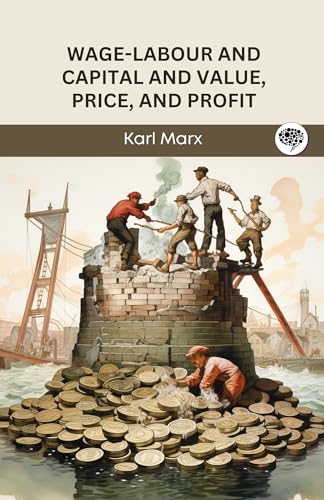
Wage-Labour and Capital and Value, Price, and Profit book cover
Wage-Labour and Capital and Value, Price, and Profit
2023
First Published
4.55
Average Rating
76
Number of Pages

"This edition of ""Wage Labour and Capital"" by Karl Marx offers readers a concise yet powerful exploration of the fundamental dynamics of capitalism. Originally published in 1849, this work is a seminal text that dissects the relationship between labor, wages, and capital in a capitalist system. In this accessible and thought-provoking essay, Marx provides a clear analysis of how capitalism operates, highlighting the exploitation inherent in the wage labor system. He outlines the stark contrast between labor and capital, emphasizing that while workers sell their labor power for wages, capitalists profit by extracting surplus value from the labor of the working class. Marx's arguments in ""Wage Labour and Capital"" are presented in a straightforward and engaging manner, making it an excellent starting point for those new to Marxist thought. He elucidates the concept of surplus value, the driving force behind capitalist production, and underscores the inevitable conflicts and contradictions between labor and capital. This book is an essential resource for anyone seeking to understand the foundational principles of Marxist economics and the critique of capitalism. In this text, Marx lays bare the exploitative nature of the capitalist system and sets the stage for his later, more comprehensive analyses of capitalism, making it an invaluable piece of the Marxist intellectual tradition."
Avg Rating
4.55
Number of Ratings
11
5 STARS
55%
4 STARS
45%
3 STARS
0%
2 STARS
0%
1 STARS
0%
goodreads

Author

Karl Marx
Karl Marx
Author · 154 books

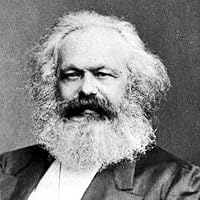
Karl Marx, Ph.D. (University of Jena, 1841) was a social scientist who was a key contributor to the development of Communist theory. Marx was born in Trier, a city then in the Kingdom of Prussia's Province of the Lower Rhine. His father, born Jewish, converted to Protestantism shortly before Karl's birth in response to a prohibition newly introduced into the Rhineland by the Prussian Kingdom on Jews practicing law. Educated at the Universities of Bonn, Jena, and Berlin, Marx founded the Socialist newspaper Vorwärts! in 1844 in Paris. After being expelled from France at the urging of the Prussian government, which "banished" Marx in absentia, Marx studied economics in Brussels. He and Engels founded the Communist League in 1847 and published the Communist Manifesto. After the failed revolution of 1848 in Germany, in which Marx participated, he eventually wound up in London. Marx worked as foreign correspondent for several U.S. publications. His Das Kapital came out in three volumes (1867, 1885 and 1894). Marx organized the International and helped found the Social Democratic Party of Germany. Although Marx was not religious, Bertrand Russell later remarked, "His belief that there is a cosmic force called Dialectical Materialism which governs human history independently of human volitions, is mere mythology" (Portraits from Memory, 1956). Marx once quipped, "All I know is that I am not a Marxist" (according to Engels in a letter to C. Schmidt; see Who's Who in Hell by Warren Allen Smith). D. 1883. Marx began co-operating with Bruno Bauer on editing Hegel's Philosophy of Religion in 1840. Marx was also engaged in writing his doctoral thesis, The Difference Between the Democritean and Epicurean Philosophy of Nature, which he completed in 1841. It was described as "a daring and original piece of work in which Marx set out to show that theology must yield to the superior wisdom of philosophy": the essay was controversial, particularly among the conservative professors at the University of Berlin. Marx decided, instead, to submit his thesis to the more liberal University of Jena, whose faculty awarded him his PhD in April 1841. As Marx and Bauer were both atheists, in March 1841 they began plans for a journal entitled Archiv des Atheismus (Atheistic Archives), but it never came to fruition. Marx has been described as one of the most influential figures in human history. Marx is typically cited, with Émile Durkheim and Max Weber, as one of the three principal architects of modern social science. More: http://en.wikipedia.org/wiki/Karl\_Marx http://plato.stanford.edu/entries/marx/ http://www.econlib.org/library/Enc/bi... http://www.marxists.org/archive/marx/... http://www.historyguide.org/intellect... http://www.bbc.co.uk/history/historic... http://www.spartacus.schoolnet.co.uk/... http://www.britannica.com/EBchecked/t...

548 Market St PMB 65688, San Francisco California 94104-5401 USA
© 2026 Paratext Inc. All rights reserved