Margins
Women in Antiquity book cover 1
Women in Antiquity book cover 2
Women in Antiquity book cover 3
Women in Antiquity
Series · 6 books · 2014-2024

Books in series

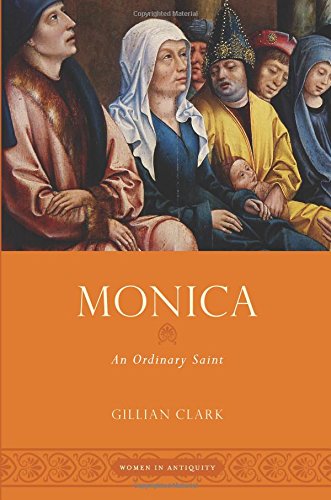
Monica book cover
#8

Monica

An Ordinary Saint

2014

Rarely did ancient authors write about the lives of women; even more rarely did they write about the lives of ordinary not queens or heroines who influenced war or politics, not sensational examples of virtue or vice, not Christian martyrs or ascetics, but women of moderate status, who experienced everyday joys and sorrows and had everyday merits and failings. Such a woman was Monica—now Saint Monica because of her relationship with her son Augustine, who wrote about her in the Confessions and elsewhere. Despite her rather unremarkable life, Saint Monica has inspired a robust controversy in academia, the Church, and the Augustine-reading public some agree with Ambrose, bishop of Milan, who knew Monica, that Augustine was exceptionally blessed in having such a mother, while others think that Monica is a classic example of the manipulative mother who lives through her son, using religion to repress his sexual life and to control him even when he seems to escape. In An Ordinary Saint, Gillian Clark reconciles these competing images of Monica's life and legacy, arriving at a woman who was shrewd and enterprising, but also meek and gentle. Weighing Augustine's discussion of his mother against other evidence of women's lives in late antiquity, Clark achieves portraits both of Monica individually, and of the many women like her. Augustine did not claim that his mother was a saint, but he did think that the challenges of everyday life required courage and commitment to Christian principle. Monica's ordinary life, as both he and Clark tell it, showed both. An Ordinary Saint illuminates Monica, wife and mother, in the context of the societal expectations and burdens that shaped her and all ordinary women.

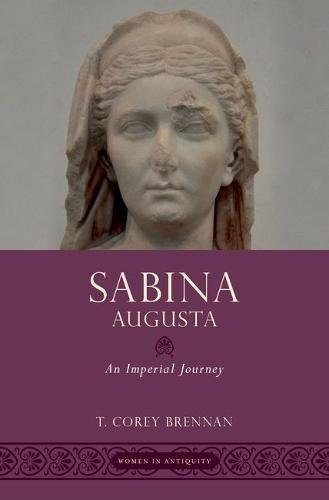
Sabina Augusta book cover
#12

Sabina Augusta

An Imperial Journey

2017

Sabina Augusta (ca. 85-ca. 137), wife of the emperor Hadrian (reigned 117-38), accumulated more public honors in Rome and the provinces than any imperial woman had enjoyed since the first empress, Augustus' wife Livia. Indeed, Sabina is the first woman whose image features on a regular and continuous series of coins minted at Rome. She was the most travelled and visible empress to date. Hadrian also deified his wife upon her death. In synthesizing the textual and massive material evidence for the empress, T. Corey Brennan traces the development of Sabina's partnership with her husband and shows the vital importance of the empress for Hadrian's own aspirations. Furthermore, the book argues that Hadrian meant for Sabina to play a key role in promoting the public character of his rule, and details how the emperor's exaltation of his wife served to enhance his own claims to divinity. Yet the sparse literary sources on Sabina instead put the worst light on the dynamics of her marriage. Brennan fully explores the various, and overwhelmingly negative, notions this empress stirred up in historiography, from antiquity through the modern era; and against the material record proposes a new and nuanced understanding of her formal role. This biographical study sheds new light not just on its subject but also more widely on Hadrian-including the vexed question of that emperor's relationship with his apparent lover Antinoos-and indeed Rome's imperial women as a group.
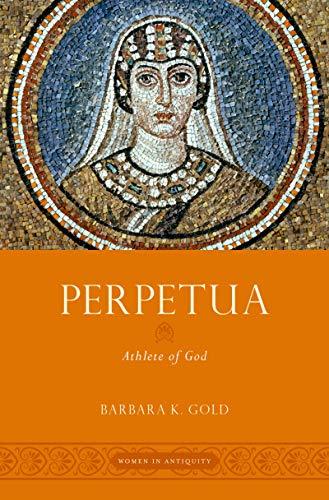
Perpetua book cover
#14

Perpetua

Athlete of God

2018

Perpetua was an early Christian martyr who died in Roman Carthage in 203 CE, along with several fellow martyrs, including one other woman, Felicitas. She has attracted great interest for two main she was one of the earliest martyrs, especially female martyrs, about whom we have any knowledge, and she left a narrative written in prison just before she went to her death in the amphitheater. Her narrative is embedded in a tripartite telling of the arrest and deaths of these martyrs, the Passio Sanctarum Perpetuae et Felicitatis. The other two parts of her tale were written by Saturus, a fellow martyr and probably her teacher, and a nameless editor or confessor, who introduces her circumstances and group and then tells of her death after she stops writing. Her story is steeped in mystery, and every aspect of her life and death has generated much controversy. Some do not believe that she herself could have written the the circumstances of her imprisonment and the limitations of her ability to write such a rhetorically complex tale are inconceivable. Some believe that her editor was none other then Tertullian, the famous 2nd-3rd century church father and Perpetua's fellow north African. Some, including Augustine, wonder why the feast day was named only for Perpetua and Felicitas and not for her fellow male martyrs. Some believe that these martyr tales were largely fabricated or constructed in order to generate publicity for the early Christians. This book will investigate and try to make sense of all aspects of Perpetua's life, death, and her family and life in Carthage, Christians and Romans in Carthage and in the Roman empire in this period, the comparisons of martyrs to athletes, the influence of these martyr tales upon the Acts of the Apostles and the Greek novel, the reactions of later church fathers like Augustine to her story and her popularity, and the gendering of this text.
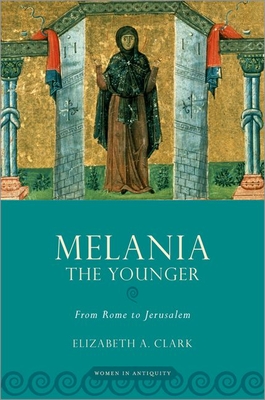
Melania the Younger book cover
#15

Melania the Younger

From Rome to Jerusalem

2021

Melania the From Rome to Jerusalem explores the richly detailed story of Melania, an early fifth-century Roman Christian aristocrat who renounced her staggering wealth to lead a life of ascetic renunciation. Hers is a tale of "riches to rags." Born to high Roman aristocracy in the late fourth century, Melania encountered numerous difficulties posed by family members, Roman officials, and historical circumstances in disposing of her wealth, property (spread across at least eight Roman provinces), and thousands of slaves. Leaving Rome with her entourage a few years before Alaric the Goth's sack of Rome in 410, she journeyed to Sicily, then to North Africa, finally settling in Jerusalem-all while founding monasteries along the way. Towards the end of her life, she traveled to Constantinople (present-day Istanbul) in an attempt to convert to Christianity her still-pagan uncle, who was on a state mission to the eastern Roman court. Throughout her life, she was accustomed to meet and be assisted by emperors and empresses, bishops, and other high dignitaries. Embracing a fairly extreme asceticism, Melania died in Jerusalem in 439. A new English translation of her Life, composed by a long-time assistant who succeeded her in the direction of the male and female monasteries in Jerusalem, accompanies this biographical study.
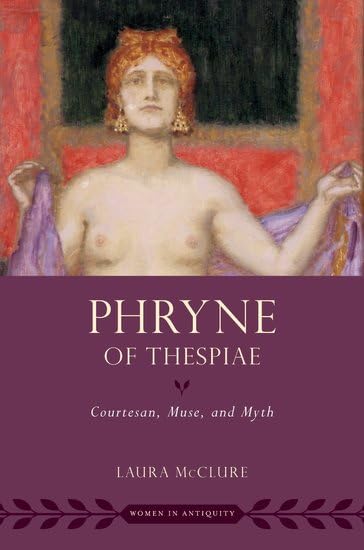
Phryne of Thespiae book cover
#22

Phryne of Thespiae

Courtesan, Muse, and Myth

2023

Although Phryne is considered the most famous of the many Greek courtesans who flocked to Athens during the fourth century BCE, there have been no modern attempts to reconstruct her life. It was not until the eighteenth century that artistic interest in her developed and her stories were continually reimagined and embellished. Artists and writers have recounted again and again how she served as the model for the Praxiteles' Cnidian Aphrodite, the first monumental female nude in Western art, and how the sight of her naked body won acquittal when she was prosecuted for impiety. However, she left no writings in her own words, and only a handful of fragments related to her have survived from her time. Until now, the primary evidence for her life comes down to us from texts composed hundreds of years after her death, all of them written by men, whose works reflect the changing tastes, experiences, and values of Greeks living under Roman rule. Phryne of Thespiae offers a close analysis of the evidence for sexual labor in classical Athens to find parallels between Phyrne and other Greek courtesans. The result is an innovative biography that examines key moments of Phyrne's life that have been dismissed as male fantasies, arguing that many of them could have plausibly originated in historical events. The portrait that emerges is that of a powerful and socially consequential woman whose wealth and connections helped to shape the society in which she lived.
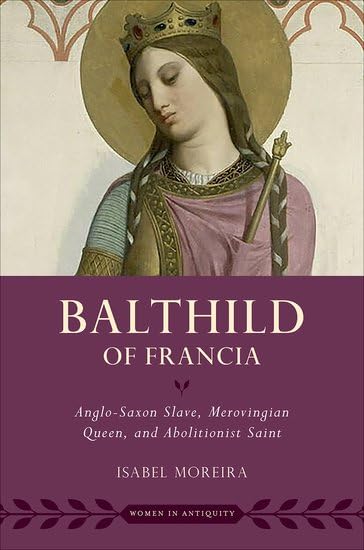
Balthild of Francia book cover
#23

Balthild of Francia

Anglo-Saxon Slave, Merovingian Queen, and Abolitionist Saint

2024

This book tells the remarkable life of Balthild of Francia (c. 633-80), a seventh-century Anglo-Saxon slave who became a queen of France. Described in contemporary sources as beautiful and intelligent, she rose to power though her marriage to the short-lived King Clovis II. As regent for her young son, she promoted social and political reforms in Francia that included the rescue and rehousing of Christian slaves who, like Balthild herself, had been caught up in the human-trafficking practices of the mid-seventh century. Implicated in the violent politics of the era, Balthild spent the remainder of her life in the convent of Chelles where a unique cache of surviving relics and personal items, including her hair, were protected and dispersed as relics over the following centuries. In the nineteenth century, Balthild's anti-slave trade policies were recalled for new audiences when she was adopted as an icon for the cause of the abolition of the slave trade and installed as one of the twenty illustrious women whose statues are situated in the Luxembourg Gardens in Paris. Although critical to her age, because of the remote time period and the specialized nature of the sources, Balthild is little known today. This book will correct this oversight by shining a light on a fascinating and courageous figure whose legacy long outlived the era to which she belonged.

Authors

Gillian Clark
Gillian Clark
Author · 1 book

Gillian Clark is a Professor of Ancient History at the University of Bristol. Professor Clark’s research field is the relationship of inherited classical culture and late antique Christianity. She works especially on Augustine and on the late Platonist philosophers Porphyry and Iamblichus, and also has a longstanding interest in women’s history and the history of gender. She directs an international collaborative and interdisciplinary project, funded for its first five years by the AHRC, for a commentary on Augustine City of God (De Civitate Dei) to be published in print and electronic versions. Professor Clark is co-editor, with Professor Andrew Louth (Durham), of the monograph series Oxford Early Christian Studies and Oxford Early Christian Texts (OUP). She is also a co-editor of Translated Texts for Historians 300-800 (Liverpool UP) and is on the editorial board of the Journal of Roman Studies. She is Chair of Directors for the Oxford Patristic Conference 2011.

Elizabeth A. Clark
Author · 7 books
Elizabeth Clark is the John Carlisle Kilgo Professor of Religion at Duke University. She is a past president of the American Academy of Religion and the North American Patristics Society.
548 Market St PMB 65688, San Francisco California 94104-5401 USA
© 2026 Paratext Inc. All rights reserved