Margins




548 Market St PMB 65688, San Francisco California 94104-5401 USA
© 2026 Paratext Inc. All rights reserved
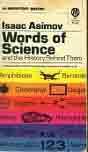
What’s in a word? Did you know that a lens is named for the lentil seed it resembles? That a straight line actually comes from the words stretched linen? or that a hippopotamus is literally a “river horse”? That oxygen means “giving birth to sharpness” because Lavoisier, who named it, mistakenly thought it was in all acids? (And acid, by the way, comes from the Latin word for vinegar). That alcohol is the word for an ancient Arabic cosmetic? That petroleum in Latin is “olive oil from a rock”? That a nucleus is a "little nut” or that deoxyribonucleic acid simply means . . . ? Well, read the book and see. The vocabulary of Science has always been a forbidding one, bristling with many-syllabled words and odd, unfamiliar terms. Now Professor Asimov has opened up this language to the ordinary reader by conducting an informal exploration into the roots and histories of hundreds of scientific terms. The result is a really fascinating book that combines a vast quantity of scientific information with an equal amount of language history. Even the longest tongue-twisters have simple origins if you go back far enough; and Professor Asimov makes each discovery of the origins of a word a sort of detective story that can’t fail to stimulate the reader’s interest. This is a perfect book to dip into again and again. Not only is it entertaining in its own right, but it is also a wonderful introduction to what should become the popular indoor sport of word-chasing. A complete index to the more than 1500 terms covered makes it a unique reference book as well.