Margins
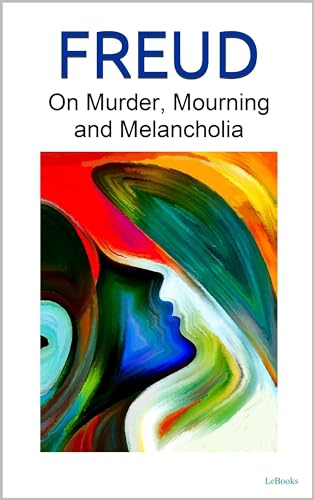
On Murder, Mourning and Melancholia - Freud book cover
On Murder, Mourning and Melancholia - Freud
2024
First Published
3.00
Average Rating
39
Number of Pages
Sigmund Freud (1856-1939) was a neurologist and important Austrian psychologist. He is considered the father of psychoanalysis and still a strong influencer of contemporary Social Psychology. The article "Mourning and Melancholia" by Sigmund Freud first appeared in 1917 in the Internationale Zeitschrif fur­Arztlich Psychoanalyse, and was later published in the first set of books of Freud's metapsychological works and General Writings on the Theory of Neuroses in 1918. In this text, Freud seeks to make considerations regarding the nature of melancholia by comparing it to the normal affect of mourning and discussing its manifestations of psychogenic origin. The correlation Freud draws between mourning and melancholia is justified by the similarity in the overall picture of these two manifestations. "Mourning and Melancholia" is a small masterpiece among the vast series of texts published by the great Austrian psychologist.

Avg Rating
3.00
Number of Ratings
1
5 STARS
0%
4 STARS
0%
3 STARS
100%
2 STARS
0%
1 STARS
0%
goodreads

Author

Sigmund Freud
Sigmund Freud
Author · 161 books

Dr. Sigismund Freud (later changed to Sigmund) was a neurologist and the founder of psychoanalysis, who created an entirely new approach to the understanding of the human personality. He is regarded as one of the most influential—and controversial—minds of the 20th century. In 1873, Freud began to study medicine at the University of Vienna. After graduating, he worked at the Vienna General Hospital. He collaborated with Josef Breuer in treating hysteria by the recall of painful experiences under hypnosis. In 1885, Freud went to Paris as a student of the neurologist Jean Charcot. On his return to Vienna the following year, Freud set up in private practice, specialising in nervous and brain disorders. The same year he married Martha Bernays, with whom he had six children. Freud developed the theory that humans have an unconscious in which sexual and aggressive impulses are in perpetual conflict for supremacy with the defences against them. In 1897, he began an intensive analysis of himself. In 1900, his major work 'The Interpretation of Dreams' was published in which Freud analysed dreams in terms of unconscious desires and experiences. In 1902, Freud was appointed Professor of Neuropathology at the University of Vienna, a post he held until 1938. Although the medical establishment disagreed with many of his theories, a group of pupils and followers began to gather around Freud. In 1910, the International Psychoanalytic Association was founded with Carl Jung, a close associate of Freud's, as the president. Jung later broke with Freud and developed his own theories. After World War One, Freud spent less time in clinical observation and concentrated on the application of his theories to history, art, literature and anthropology. In 1923, he published 'The Ego and the Id', which suggested a new structural model of the mind, divided into the 'id, the 'ego' and the 'superego'. In 1933, the Nazis publicly burnt a number of Freud's books. In 1938, shortly after the Nazis annexed Austria, Freud left Vienna for London with his wife and daughter Anna. Freud had been diagnosed with cancer of the jaw in 1923, and underwent more than 30 operations. He died of cancer on 23 September 1939.

548 Market St PMB 65688, San Francisco California 94104-5401 USA
© 2025 Paratext Inc. All rights reserved