Margins
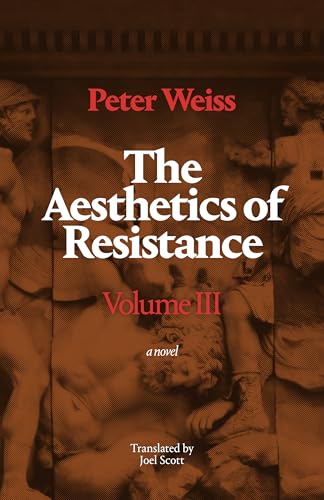
The Aesthetics of Resistance, Volume III book cover
The Aesthetics of Resistance, Volume III
A Novel
1981
First Published
4.71
Average Rating
296
Number of Pages

Part of Series

Ce troisieme volume est moins la chronique que la synthese politique et historique d'evenements de ce siecle. Au premier plan cette fois, le destin de chaque individu vu jusqu'alors dans un errance des parents du narrateur chasses par les persecutions nazies de camp en camp ou ils sont temoins des horreurs perpetrees; suicide de l'ecrivain Karin Boye que l'enormite de ces horreurs reduit au silence; inconcevables difficultes des refugies politiques en Suede; combats des antifascistes dans la clandestinite en Allemagne nazie et aneantissement des membres berlinois de ce qui fut l'"orchestre rouge". Et parallelement toujours une reflexion sur le sens de l'art et sa force dans l'expression de la realite politique. Et l'espoir, l'endurance de ceux qui, ainsi que l'exprime Heilmann dans la lettre-testament redigee la nuit precedant son "Ce que nous avons voulu saisir n'a jamais pu etre prouve. Notre message resta plutot modeste. Il y avait parmi nous des scientifiques, des artistes. Meme leur esprit n'a pas suffit pour gagner le monde a notre dessein. Il y avait aussi un sculpteur, son oeuvre etait mince, et un ecrivain, ses poemes et ses romans n'entreront pas dans l'histoire de la litterature. Ils travaillaient pourtant avec autant de passion que ceux qui seront peut-etre epargnes et vous laisseront quelque chose qui vous enrichira. Ce que je veux dire, c'est que leurs realisations ne peuvent etre mesurees aux criteres evidents pour tous, qu'il faudra un jour inventer une nouvelle balance qui rendra justice au poids de leur vie. Il y a quelques mois encore, je deplorais de ne pouvoir connaitre ce qui commencera, a present il me suffit de n'avoir jamais fait autre chose que ce que j'ai tenu pour juste, meme si ce qui est juste tend de nouveau a s'estomper."

Avg Rating
4.71
Number of Ratings
31
5 STARS
77%
4 STARS
19%
3 STARS
0%
2 STARS
3%
1 STARS
0%
goodreads

Author

Peter Weiss
Peter Weiss
Author · 12 books

Peter Ulrich Weiss was a German writer, painter, and artist of adopted Swedish nationality. He is particularly known for his play Marat/Sade and his novel The Aesthetics of Resistance. Weiss' first art exhibition took place in 1936. His first produced play was Der Turm in 1950. In 1952 he joined the Swedish Experimental Film Studio, where he made films for several years. During this period, he also taught painting at Stockholm's People's University, and illustrated a Swedish edition of The Book of One Thousand and One Nights. Until the early 1960s, Weiss also wrote prose. His work consists of short and intense novels with Kafkaesque details and feelings, often with autobiographical background. One of the most known films made by Peter Weiss is an experimental one, The Mirage (1959) and the second one - it is very seldom mentioned - is a film Weiss directed in Paris 1960 together with Barbro Boman, titled Play Girls or The Flamboyant Sex (Schwedische Mädchen in Paris or Verlockung in German). Among the short films by Weiss, The Studio of Doctor Faust (1956) shows the extremely strong link of Weiss to a German cultural background. Weiss' best-known work is the play Marat/Sade (1963), first performed in West Berlin in 1964, which brought him widespread international attention. The following year, legendary director Peter Brook staged a famous production in New York City. It studies the power in society through two extreme and extremely different historical persons, Jean-Paul Marat, a brutal hero of the French Revolution, and the Marquis de Sade, for whom sadism was named. In Marat/Sade, Weiss uses a technique which, to quote from the play itself, speaks of the play within a play within itself: "Our play's chief aim has been to take to bits great propositions and their opposites, see how they work, and let them fight it out." The play is considered a classic, and is still performed, although less regularly. Weiss was honored with the Charles Veillon Award, 1963; the Lessing Prize, 1965; the Heinrich Mann Prize, 1966; the Carl Albert Anderson Prize, 1967; the Thomas Dehler Prize, 1978; the Cologne Literature Prize, 1981; the Bremen Literature Prize, 1982; the De Nios Prize, 1982; the Swedish Theatre Critics Prize, 1982; and the Georg Büchner Prize, 1982. A translation of Weiss' L'instruction (Die Ermittlung) was performed at London's Young Vic theater by a Rwandan company in November 2007. The production presented a dramatic contrast between the play's view on the Holocaust and the Rwandan actors' own experience with their nation's genocide. http://literaturkritik.de/public/reze... http://literaturkritik.de/public/reze...

548 Market St PMB 65688, San Francisco California 94104-5401 USA
© 2026 Paratext Inc. All rights reserved